You can see everything

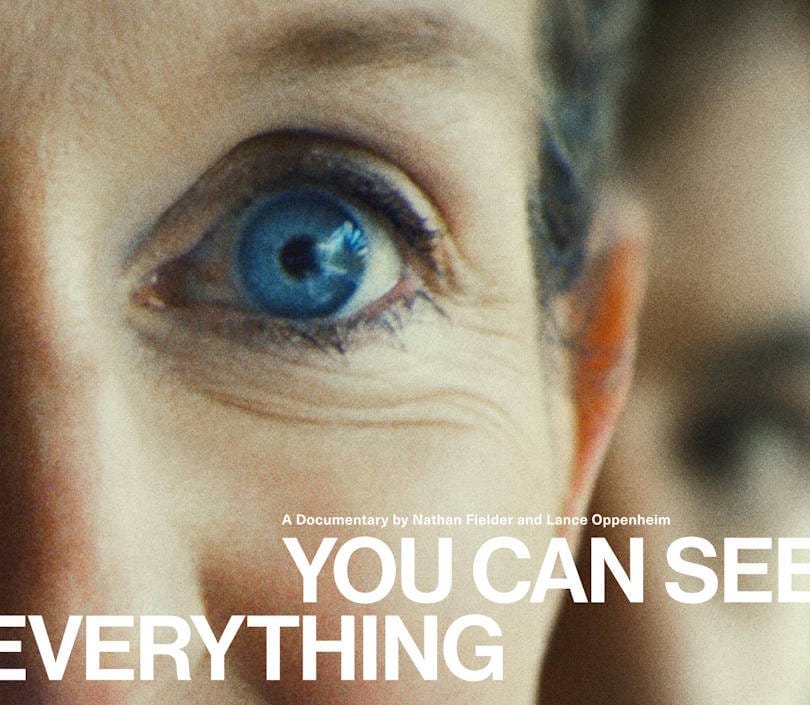
I spent 3 hours watching this documentary and another 3 days thinking about it.
Thirty-four days before she’s sent to prison, notorious Silicon Valley founder Elizabeth Holmes (Liz) invites a skeptical film crew to document her every move.
The crew is led by comedian Nathan Fielder (Nat).
Nat moves into the beach house Liz shares with her partner, Billy Evans, and their two young children. Billy turns out to be half the story. Liz texts Nat: “fyi you can totally see everything.”
You probably know the first act.
Liz is 42 now. She dropped out of Stanford at 19 and started Theranos in 2003.
The pitch was hundreds of blood tests from a single finger prick. By 2014 the company was worth $9 billion and she was the youngest self-made female billionaire in America. Henry Kissinger, George Shultz and James Mattis sat on her board.
But at that moment in time, the technology didn’t work. The Wall Street Journal exposed it in 2015. Theranos shut down in 2018. In 2022 a jury convicted Liz of defrauding investors and a judge sentenced her to more than 11 years behind bars.
Halfway through the film, Liz reports to prison. Nat brings in Amanda Seyfried, who played Liz in The Dropout, to reenact the conversations he couldn’t film.
Amanda watches the footage and says what the whole cinema is thinking: something weird is going on.
Ironically, the only professional actor in the documentary is the one who can see through the act.
Liz should win the Oscar for best actress.
Except she isn’t acting. Her behaviour combines ten traits of high-powered billionaire entrepreneurs, taken to the extreme.
I interview founders for Forbes. I recognised every one of these.
1. Reality distortion field
Making people believe in a future so hard they treat it as already decided.
Steve Jobs. In 1981, Apple engineer Bud Tribble gave it a name: Steve had a reality distortion field. He once told an engineer, “If it could save a person’s life, would you find a way to shave ten seconds off the boot time?” His team hit deadlines they had called impossible, and the Macintosh shipped in 1984.
At their first meeting, Nat told Liz nobody would ever believe a word she said. By the end, he’s rewriting a line of his reenactment script so she looks less calculating. Amanda calls him out for protecting her.
2. Halo effect
Being so impressive in one area that people assume you’re impressive in all of them.
Sam Bankman-Fried. The maths prodigy in shorts who said he would give his billions away. During his pitch to Sequoia, one partner typed: “I LOVE THIS FOUNDER” into the group chat. FTX reached a $32 billion valuation. In 2022 it collapsed, with billions of dollars of customer money gone. In 2023 a jury convicted him of fraud. He’s serving 25 years.
Liz’s name still sells. She sits under bright lights with dots drawn on her face while more than 200 cameras capture her. Billy licenses her image for billboards and an AI version of her.
3. Laws of physics
Believing technical limits will give way to enough determination.
Elon Musk. “The only rules are the ones dictated by the laws of physics. Everything else is a recommendation.” The industry threw rockets away after every launch. In 2015, SpaceX landed one. Now landing and reusing boosters is routine for SpaceX.
Nat presses Liz on saying Theranos devices “can” run hundreds of tests. Her whole defence rests on one word. She meant “can” as in one day, once the science exists. A jury heard that defence and convicted her. She keeps saying it.
4. Higher purpose and grand vision
A mission big enough to justify everything, in their eyes.
Adam Neumann. WeWork leased desks. Its stated mission was to elevate the world’s consciousness. “Our valuation and size today are much more based on our energy and spirituality than it is on a multiple of revenue,” he said in 2017. By 2019 WeWork was valued at $47 billion. Then the IPO filing showed the losses, the IPO collapsed and Adam was pushed out, reportedly with a package worth over $1 billion. WeWork filed for bankruptcy in 2023.
Liz approached A24 about a documentary before Nat was involved. The new mission is her own name. She’s convinced everyone will believe her once she gets to tell her side.
5. Media training and controlling the interview
Answering the question you want to answer instead
Mark Zuckerberg. In 2018, after Cambridge Analytica, Congress questioned him for two days. Pressed on specifics, he told senator after senator, “My team will follow up with you.” Facebook’s share price went up during the hearing.
Listen to how Liz answers questions. She rarely answers the one she was asked. She delivers the message she came to deliver. Politicians do this all the time. Nat asks her a yes or no question. Have you ever told a lie? “I don’t think so.”
6. Missing small details
A big-picture brain that leaves the small stuff to someone else.
Richard Branson. “I was 50 before I learnt the difference between net and gross.” A board member had to explain it with a fishing net. By then he had built Virgin into a global brand.
Liz is beating eggs. Billy takes the bowl out of her hands. She lets him. When Nat asks why, she says Billy thinks she doesn’t do it right and he can do it quicker. Later Nat plays her Abbott and Costello’s “Who’s on first?”, maybe the most famous comedy routine of all time. But the humour goes over her head. She says she doesn’t get it.
7. Knowing how to make a situation look a certain way
Controlling how something looks to other people.
Steve Jobs again. “Every once in a while, a revolutionary product comes along that changes everything,” he told the room in January 2007. The iPhone in his hand still crashed. But his engineers had mapped out the exact sequence of taps that would hold together on stage, so the demo went perfectly. The phone shipped that June.
Liz is no stranger to staging appearances. In 2015, Joe Biden toured a Theranos facility and called it a "laboratory of the future." Former employees later said the room had been freshly painted and filled with machines that weren't actually performing tests. In the documentary, Liz has traded her black turtleneck and red lipstick for a beige crewneck and frayed jeans. The billionaire founder has become the ordinary mum next door.
8. Selective ignorance
Knowing every detail that helps you and none that could hurt you.
Brian Chesky. “There are laws for people and laws for business, but you are a new category, a third category, people as businesses,” he told his hosts. Airbnb spread into cities that restricted short-term rentals and left hosts to check the local rules. By the time cities caught up, Airbnb was worth $100 billion. When New York enforced its rules in 2023, thousands of listings disappeared.
Liz and Billy insist she was misquoted in her 2023 New York Times interview, particularly about her old persona being a character she created. They say they recorded the conversation. When Nat asks to hear it, they refuse. The journalist stands by her reporting. Liz and Billy maintain their version without producing the evidence they claim to possess.
9. Business above everything else
The company becomes the organising principle of life.
Elon Musk again. “Nobody ever changed the world on 40 hours a week,” he tweeted in 2018. That year, during the Model 3 production crunch, he slept on the Tesla factory floor. By the end of June, Tesla was building 5,000 Model 3s a week.
Liz has 34 days left with her two young children before prison. She spends them making a documentary. A film crew in the kitchen, the bedroom, on the beach. Between scenes, she shows Nat a Theranos device and calls potential investors.
10. Chess, strategy and games
Nothing is personal. Everything is a move.
Bill Gates. In 1980, Microsoft licensed DOS to IBM and kept the right to sell it to every other computer maker. The clones came. Microsoft ended up on nearly every PC in the world, and Bill became the richest man on the planet.
Liz and Billy describe a bond so deep they don't even need to speak to know what the other is thinking. Then, in a meeting before filming begins, Liz leaves the room to check on the kids. Billy asks A24 for a cut of the profits. Later, Liz insists she has no financial interest in the film. Nat wonders if Billy has gone behind her back. I suspect Liz knows exactly what she's doing. She's constructed a story in which Billy appears to have betrayed her, leaving her innocent of the financial demands. What if Billy is simply another pawn in her game?
Here's what I can't stop thinking about.
Liz is 42. She's currently scheduled for release in 2030, when she'll be 46. Research from MIT found that the average age of founders behind the fastest-growing 0.1% of startups is 45.
I don't think Liz has any intention of stopping.
I think she still believes she'll go down as one of the greatest founders of all time. That her mission will be complete. That Theranos, the trial and the prison sentence will eventually become footnotes in a much bigger story.
For most people, going to prison for 11 years would be catastrophic. I suspect Liz sees it as another chapter in her founder story.
Every behaviour on this list gets celebrated in founders.
You’ll recognise some of them in yourself. They’re part of why you’ve built what you have.
But Liz took all ten to the extreme, all at the same time, with nobody around to stop her.
So is Liz:
Evil or genius?
Naive or calculated?
Ravenclaw or Slytherin?
Straight to your inbox. Copy, paste, done.